
The History of BYD: From Battery Maker to Global EV Giant
The History of BYD: From Battery Maker to Global EV Giant
Aratrika Roy
·Updated ·5 min read
The History of BYD: From Battery Maker to Global EV Giant
Introduction
BYD (Build Your Dreams) is one of the world's fastest-growing electric vehicle (EV) manufacturers and a global leader in battery technology. What started as a small rechargeable battery company in China has transformed into a multinational powerhouse producing electric cars, buses, trucks, energy storage systems, and advanced batteries. Today, BYD competes with some of the biggest automotive brands in the world and has become a symbol of China's rapid rise in the electric mobility revolution.
The Foundation of BYD
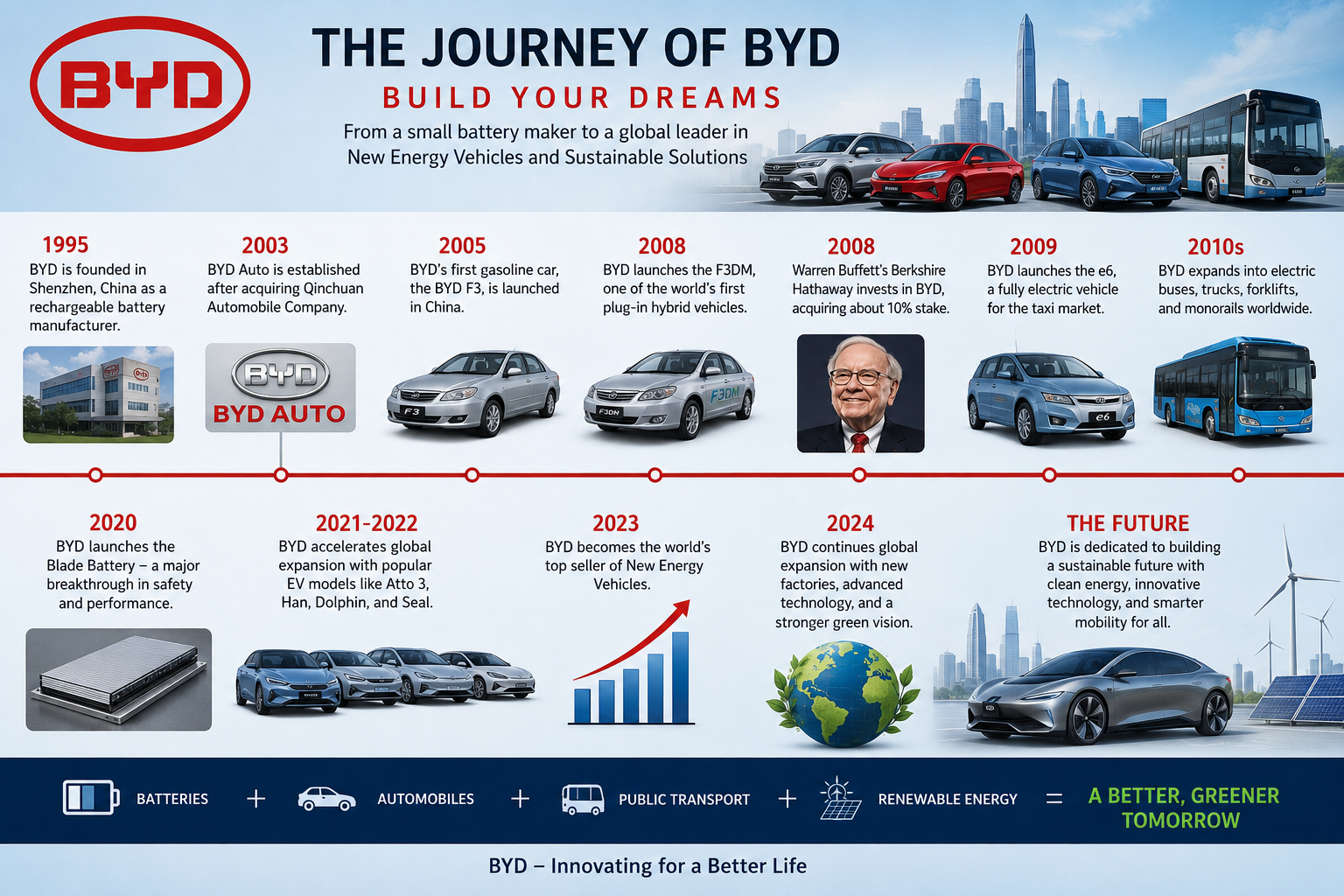
BYD was founded in February 1995 by Wang Chuanfu in Shenzhen, China. At the time, the company had fewer than 30 employees and focused solely on manufacturing rechargeable batteries. Initially, BYD supplied nickel-cadmium (NiCd) batteries for mobile phones and other electronic devices.
The company quickly gained recognition for producing high-quality batteries at competitive prices. As demand for mobile electronics grew during the late 1990s, BYD expanded rapidly and became one of the world's largest battery manufacturers.
Expansion into the Automotive Industry
In 2003, BYD made a bold move by acquiring Qinchuan Automobile Company, marking its entry into the automotive industry. Many experts questioned this decision because BYD had no experience in car manufacturing.
Despite the skepticism, BYD believed that combining battery expertise with automobile production would give it a competitive advantage in the future.
The company's first gasoline-powered vehicle, the BYD F3, was launched in 2005. The sedan became a huge success in China due to its affordable price, reliability, and modern features.
Entering the Electric Vehicle Market
BYD's real vision was always electric mobility. Leveraging years of battery research, the company introduced some of the world's earliest mass-produced plug-in hybrid and electric vehicles.
In 2008, BYD launched the F3DM, one of the world's first mass-produced plug-in hybrid electric vehicles (PHEVs). This milestone demonstrated the company's commitment to sustainable transportation long before electric cars became mainstream.
A year later, BYD introduced the e6, a fully electric vehicle designed primarily for taxi fleets and commercial use. The e6 gained popularity in several countries due to its long driving range and durable battery system.
Warren Buffett's Investment
A major turning point in BYD's history came in 2008, when Berkshire Hathaway, led by legendary investor Warren Buffett, purchased approximately a 10% stake in the company.
This investment significantly increased BYD's global credibility. Investors around the world began paying closer attention to the Chinese manufacturer, recognizing its potential to lead the future of electric transportation.
The partnership also highlighted confidence in BYD's technology, innovation, and long-term business strategy.
Becoming a Global EV Leader
Throughout the 2010s, BYD expanded beyond passenger cars. The company began manufacturing electric buses, trucks, forklifts, and monorail systems.
Today, BYD electric buses operate in cities across:
Europe
North America
South America
Asia
Australia
Many governments chose BYD buses because of their reliability, lower operating costs, and zero tailpipe emissions.
The company also established manufacturing facilities in several countries to support growing international demand.
Innovation in Battery Technology
Battery technology remains BYD's greatest strength.
One of its biggest breakthroughs came with the introduction of the Blade Battery in 2020. Based on lithium iron phosphate (LFP) chemistry, the Blade Battery offers several advantages:
Improved safety
Longer lifespan
Better thermal stability
Lower production costs
Reduced fire risk
The Blade Battery successfully passed several extreme safety tests, including nail penetration tests that often cause conventional lithium-ion batteries to catch fire.
This innovation helped BYD gain a significant competitive advantage in the global EV market.
Expansion Beyond China
BYD gradually expanded into international markets by exporting electric vehicles to Europe, Southeast Asia, Australia, South America, and the Middle East.
The company launched popular models such as:
BYD Atto 3
BYD Dolphin
BYD Seal
BYD Han
BYD Tang
BYD Yuan Plus
These vehicles received positive reviews for their modern technology, long range, premium interiors, and competitive pricing.
As demand for electric vehicles increased globally, BYD accelerated its international expansion strategy by partnering with local dealerships and establishing new production facilities.
BYD in India
BYD entered the Indian market with electric commercial vehicles before introducing passenger EVs.
Some of its popular Indian models include:
BYD Atto 3
BYD Seal
BYD eMAX 7
The company aims to strengthen its presence by offering premium electric vehicles equipped with advanced safety features, high-performance batteries, and cutting-edge technology.
India represents an important growth market as the country continues its transition toward sustainable transportation.
Record-Breaking Growth
In recent years, BYD has experienced remarkable sales growth.
The company has consistently ranked among the world's top manufacturers of plug-in hybrid and battery electric vehicles. Its vertically integrated business model allows BYD to manufacture many key components—including batteries, electric motors, semiconductors, and power electronics—in-house.
This strategy helps reduce production costs, improve supply chain efficiency, and maintain strict quality control.
BYD has also become a major supplier of batteries to other automotive companies, further strengthening its position in the global EV ecosystem.
Commitment to Sustainability
BYD's mission extends beyond manufacturing cars.
The company actively invests in:
Renewable energy
Energy storage solutions
Electric public transportation
Solar power technology
Sustainable manufacturing
Its vision is to reduce dependence on fossil fuels while promoting clean energy solutions worldwide.
The Future of BYD
Looking ahead, BYD plans to continue expanding its global footprint through innovation, research, and technological advancement.
Future priorities include:
Next-generation battery technologies
Autonomous driving features
Smarter connected vehicles
Global manufacturing expansion
Carbon-neutral production
With governments worldwide encouraging electric mobility, BYD is well-positioned to remain one of the industry's leading players.
Conclusion
BYD's journey from a small battery manufacturer in Shenzhen to one of the world's largest electric vehicle companies is a remarkable story of innovation, determination, and strategic vision. By combining expertise in battery technology with automotive engineering, BYD has reshaped the global EV industry. Its continuous investment in research, sustainable technology, and international expansion ensures that the company will play a crucial role in the future of transportation. As electric vehicles become increasingly important worldwide, BYD stands as a shining example of how innovation can transform an entire industry.