
The History of Volvo: A Legacy of Safety, Innovation, and Scandinavian Excellence
The History of Volvo: A Legacy of Safety, Innovation, and Scandinavian Excellence
Aratrika Roy
·Updated ·4 min read
The History of Volvo: A Legacy of Safety, Innovation, and Scandinavian Excellence
Introduction
Volvo is one of the world's most respected automobile manufacturers, renowned for its commitment to safety, reliability, and premium Scandinavian design. Founded in Sweden, the company has evolved from a small automotive venture into a global brand producing luxury cars, SUVs, trucks, buses, construction equipment, and electric vehicles. Today, Volvo is at the forefront of sustainable mobility and aims to become a fully electric car manufacturer in the coming years.
The Birth of Volvo
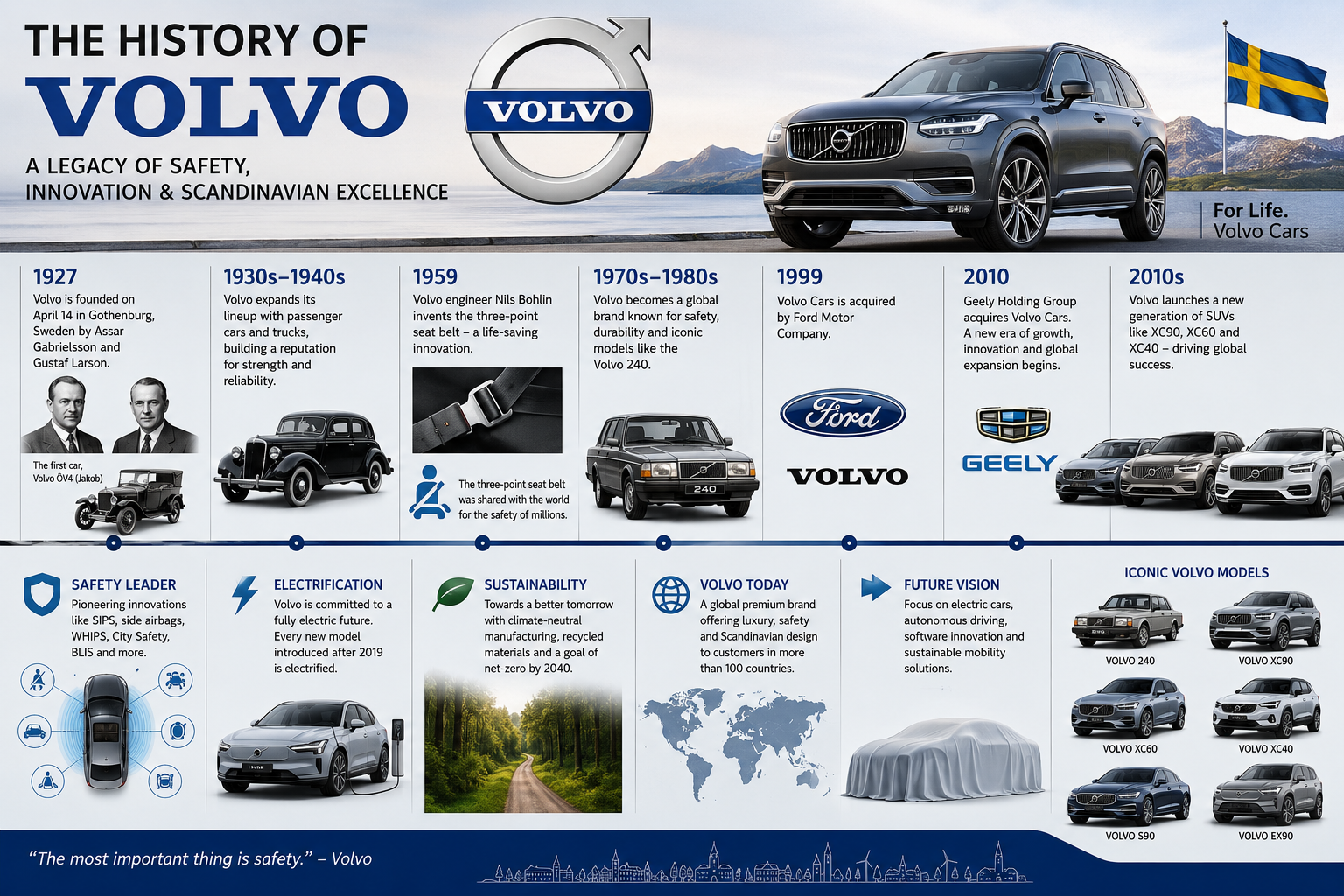
Volvo was founded on April 14, 1927, in Gothenburg, Sweden, by Assar Gabrielsson and Gustaf Larson. The name "Volvo" comes from the Latin word meaning "I roll."
Originally, Volvo was a subsidiary of the Swedish bearing manufacturer SKF (Svenska Kullagerfabriken). The founders wanted to build vehicles capable of withstanding Sweden's harsh climate and rough roads while offering exceptional durability and safety.
The company's first production car was the Volvo ÖV4, affectionately nicknamed "Jakob."
Early Growth
During the 1930s and 1940s, Volvo expanded its lineup with passenger cars and commercial vehicles. The company quickly earned a reputation for producing strong, dependable automobiles that could handle demanding road conditions.
Volvo also entered the truck manufacturing business, which would later become one of the company's largest global operations.
Volvo Becomes a Safety Pioneer
Safety has always been Volvo's defining characteristic.
In 1959, Volvo engineer Nils Bohlin invented the three-point seat belt, one of the most important automotive safety innovations in history.
Rather than keeping the invention exclusive, Volvo made the patent available to the entire automotive industry free of charge, helping save millions of lives worldwide.
Over the following decades, Volvo introduced numerous safety innovations, including:
Side Impact Protection System (SIPS)
Side airbags
Curtain airbags
Whiplash Protection System (WHIPS)
Blind Spot Information System (BLIS)
City Safety automatic emergency braking
Pedestrian and cyclist detection
These innovations cemented Volvo's reputation as the world's safety leader.
Expansion into Global Markets
By the 1970s and 1980s, Volvo had become a well-known premium automotive brand in Europe and North America.
Popular models such as the:
Volvo 240
Volvo 740
Volvo 850
became famous for their durability, practicality, and industry-leading safety standards.
The iconic Volvo station wagons also gained a loyal following among families and professionals.
Ford Ownership
In 1999, Volvo Cars was acquired by Ford Motor Company as part of its Premier Automotive Group.
During this period, Volvo introduced several successful luxury vehicles, including:
Volvo XC90
Volvo S60
Volvo XC70
Volvo C30
Ford invested heavily in improving Volvo's technology and expanding its global presence.
Geely Acquisition
A major turning point came in 2010, when China's Geely Holding Group acquired Volvo Cars from Ford.
Many industry experts were initially skeptical, but the acquisition proved highly successful.
Under Geely's ownership, Volvo retained its Swedish identity while gaining access to significant financial resources for research, development, and global expansion.
The SUV Revolution
Volvo experienced remarkable growth after launching its modern SUV lineup.
Key models included:
Volvo XC40
Volvo XC60
Volvo XC90
These SUVs combined elegant Scandinavian design, luxurious interiors, advanced safety features, and efficient powertrains, becoming popular in markets worldwide.
Electrification Strategy
Volvo has become one of the automotive industry's leaders in electrification.
The company pledged that every new model introduced after 2019 would include some form of electrification.
Its growing EV lineup includes:
Volvo EX30
Volvo EX40
Volvo EC40
Volvo EX90
Volvo is investing heavily in battery technology, software-defined vehicles, and sustainable manufacturing to support its vision of a zero-emission future.
Sustainability Initiatives
Beyond electric vehicles, Volvo is committed to reducing its environmental impact through:
Carbon-neutral manufacturing
Recycled interior materials
Renewable energy in production facilities
Sustainable supply chains
Circular economy initiatives
The company aims to achieve net-zero greenhouse gas emissions by 2040.
Volvo in India
Volvo entered the Indian market with premium luxury vehicles and has steadily expanded its presence.
Popular Volvo models in India include:
Volvo XC40 Recharge
Volvo XC60
Volvo XC90
Volvo S90
Volvo C40 Recharge (where available)
The brand is recognized for offering world-class safety, luxury, and cutting-edge technology to Indian customers.
Looking Ahead
The future of Volvo revolves around:
Fully electric vehicles
Advanced driver-assistance systems
Autonomous driving technology
Software-based vehicle platforms
Sustainable manufacturing
Connected mobility solutions
The company continues to invest in innovation while maintaining its core philosophy of protecting people and the environment.
Conclusion
From its humble beginnings in Sweden in 1927 to becoming one of the world's most respected premium automotive brands, Volvo has built its reputation on safety, innovation, quality, and sustainability. Its invention of the three-point seat belt changed the automotive industry forever, while its commitment to electrification ensures that Volvo remains prepared for the future. With a rich heritage and a clear vision for cleaner mobility, Volvo continues to set standards that inspire the global automotive industry.